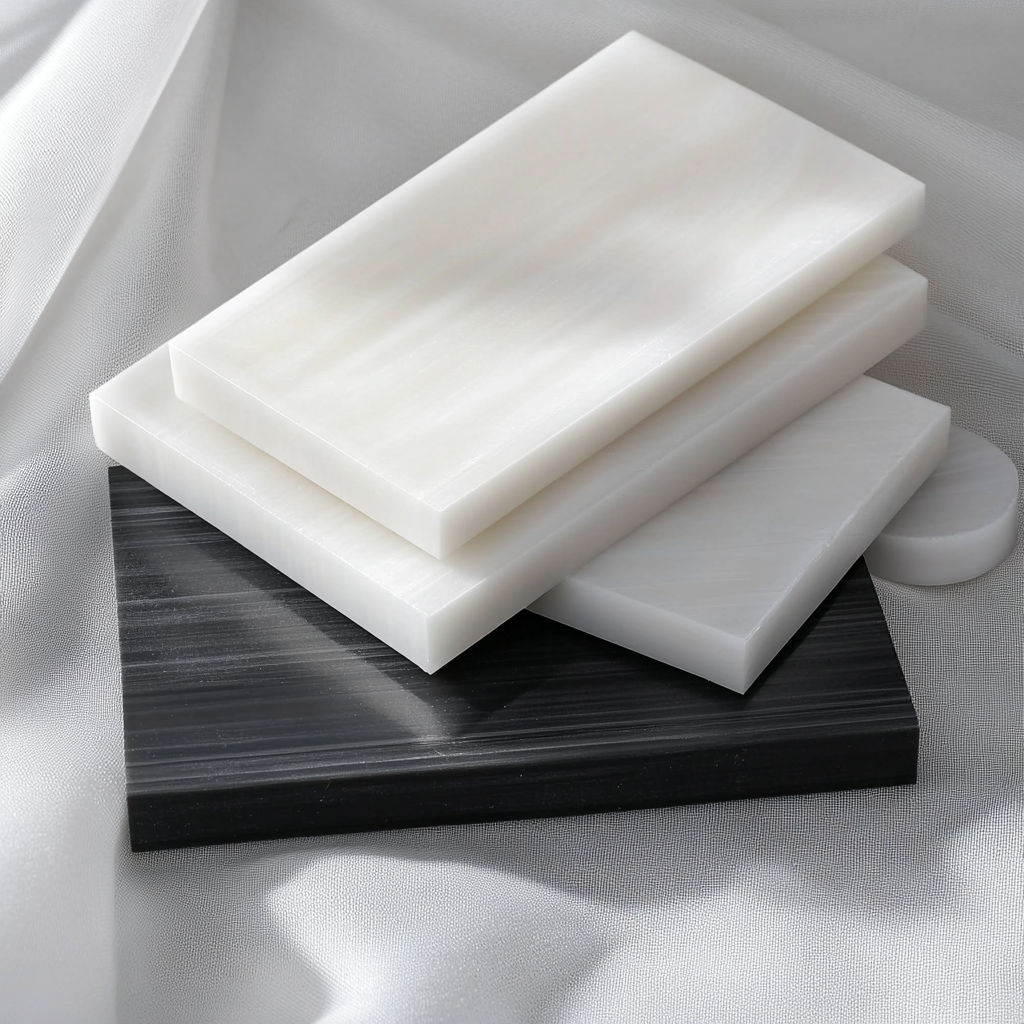
Aluminum composite panel — Dibond, Alupanel, Max-Metal. Matte white and black, 2mm and 3mm, stocked 4×8 and 5×10 in Sparks. Cut, routed and V-grooved to fold.
ACM is a sandwich: thin aluminium on both faces, a polymer core between them. It gives you the flatness and edge of metal at a fraction of the weight, it routs and folds into finished shapes, and it takes print and vinyl straight off the sheet. If your drawing says Dibond, Alupanel, Alumalite or Max-Metal, it means this. Our panel comes through Calsak, whose ACM line is Aluplast. Two things decide which sheet you actually want — the skin thickness and the core — and both are covered below, because most suppliers will sell you a sheet without mentioning either.
Matte finish across the board, cut to size same day. The gauges are drawn edge-on beside each size, all at the same scale — at 2mm and 3mm the difference is real but small, which is exactly why the skin matters more than the panel thickness on most jobs.
| Panel | Decimal | Edge on, to scale | Colour & size |
|---|---|---|---|
| 2 mm | 0.079″ | White · 4×8 | |
| 3 mm .005 skin | 0.118″ | White · 4×8 | |
| 3 mm .008 skin | 0.118″ | White · 4×8 | |
| 3 mm | 0.118″ | Black · 4×8 and 5×10 |
The 5×10 black is the one worth knowing about. Most shops only stock 4×8, so a 9-foot panel becomes a seam. Brushed, anodised and colour-matched faces, 4mm and 6mm panels, and other sheet sizes all come in on a short lead time.
We stock 3mm white in two skin thicknesses, and the number is the aluminium face in inches. Same panel thickness, same finish, different sheet — and the price gap is small enough that people pick by habit rather than by job.
The economy face. Right for flat panel signage, printed graphics, real estate and site signs, temporary work and anything that gets mounted flush and left alone. Lighter, cheaper, and perfectly flat out of the box.
The heavier face. Right for routed and folded work, dimensional letters, panels that get handled, installed at height or touched by the public, and anything where a dent shows. Folds cleaner and holds an edge better.
Short version: if the panel stays flat and nobody touches it, .005. If it gets folded, handled, or lives somewhere a ding would be visible, .008. Tell us which the job is and we will pull the right one — the difference on a sheet is a few dollars and the difference on a finished install is obvious.
Sign-grade ACM — what we stock, and what every sign supplier stocks — uses a polyethylene core. That is the correct product for signage, interior panels, fascia trim and low-rise work, and it is what almost every ACM job in this market actually is.
It is not the product for a commercial building facade. Under IBC Section 1403.5, exterior wall assemblies on buildings over 40 feet in Type I, II, III and IV construction have to pass NFPA 285, and polyethylene-core ACM does not pass it. Several major cities have gone further and restricted PE core on high-rise exteriors outright.
And here is the part that catches people: NFPA 285 tests a complete two-storey wall assembly, not a sheet of material. An ASTM E84 Class A rating on an ACM panel does not demonstrate that your wall passes NFPA 285. Anyone who hands you a Class A number and calls the cladding question settled has answered a different question than the one your inspector is asking.
| Core | What it is | Where it belongs |
|---|---|---|
| Polyethylene (PE) | Solid polymer core. The standard sign panel. | Signage, interior, fascia, low-rise. What we stock. |
| Fire retardant (FR) | Mineral-loaded core. Can pass NFPA 285 as part of a tested assembly — performance depends on the rest of the wall, not just the panel. | Commercial exteriors where the assembly has been tested. Order-in. |
| Mineral / A2 | Highest fire classification, passes NFPA 285 across the widest range of assemblies. | High-rise and the strictest jurisdictions. Order-in. |
So: if you are making a sign, buy off our rack. If you are cladding a building, tell us the height, the construction type and whether the assembly has an NFPA 285 listing, and we will get you the right core and the manufacturer’s documentation to go with it. That is a longer conversation and a longer lead time, and it is a great deal shorter than the one that starts after an inspector red-tags a facade.
| Property | Typical value | What it means on the job |
|---|---|---|
| Construction | Aluminium / polymer core / aluminium | Metal face and edge, plastic weight and workability |
| Panel thickness | 2 mm, 3 mm stocked | 3mm is the signage default; 2mm for lighter flat work |
| Skin thickness | .005″ and .008″ stocked | The decision that matters more than panel thickness |
| Weight, 3 mm | ~0.55 lb/ft² | Roughly a third of solid aluminium at 1/8″ |
| Outdoor service life | 7–10+ years | Longest of the four sign substrates by a wide margin |
| Flatness | Excellent | Will not oil-can across a large panel |
| Fabrication | Route, V-groove, fold, drill, shear | Ordinary carbide tooling. No welding required |
| Finish | Matte white, matte black | Print- and vinyl-ready without primer |
| Exterior service | Good, factory-finished faces | Years outdoors. The face is coated aluminium, not painted plastic |
| Core, stocked grade | Polyethylene | Signage and low-rise. Not for facades over 40 ft |
Typical published values for sign-grade aluminium composite panel, given as a design starting point rather than a specification. If your job turns on a number — a wind load, a weight, a fire classification — ask and we will supply the manufacturer’s data sheet for the exact panel we are shipping you.
This is the chart that decides most exterior sign jobs, and the gap is not close. ACM outlasts expanded PVC outdoors by something like five to one, because the face is factory-coated aluminium rather than a plastic surface holding pigment. If the sign has to survive a Nevada summer more than once, the substrate question is already answered.
The useful comparison is the last row. ACM gives you a metal face, a metal edge and metal flatness at roughly a third the weight of solid aluminium — which is the entire reason the material exists. Against the plastics it is mid-pack on weight and first on service life.
The two sign substrates that get confused, and the answer is mostly about sun and size. PVC foam board is lighter and cheaper, cuts on a table saw, takes a screw straight into the edge, and is the right call for interior signage, backers, shaped letters and anything that lives out of the weather. ACM is the right call for a large panel, a panel in full sun, or a panel that has to stay dead flat for years. Two numbers settle it: expanded PVC is rated 6 months to 2 years outdoors, ACM 7 to 10 or more. Expanded PVC also moves roughly ten times as much as wood with temperature — a 12-foot board can travel about a quarter inch across one hot day — which is how a big PVC panel ends up wavy by its second summer. If it is going outdoors and it is bigger than a couple of feet, it is an ACM job. Full side-by-side with the numbers →
ACM cuts on a panel saw, routs with ordinary carbide tooling, and shears and drills like sheet metal. The capability that makes it worth bringing to us is V-grooving — a groove cut through the front skin and core but not the back skin, so the panel folds cleanly along the line into a return or a box. We cut it to size and CNC rout it in our Sparks shop, from a DXF or from a drawing. It cannot be solvent-cemented or plastic welded — assemblies get folded, riveted, bonded with structural tape or mechanically fastened.
Yes. ACM is the material — aluminium composite material. Dibond is a brand of it, the way Lexan is a brand of polycarbonate. So are Alupanel, Max-Metal, Omega-Bond and e-panel. Ask for whichever name is on your drawing and we will know what you mean — and if the drawing calls out a brand for a reason, such as a specific fire listing, tell us that too, because then the brand genuinely matters. More brand names, translated →
On a low-rise building, under 40 feet, generally yes. On a taller commercial building, not the panel we stock. IBC Section 1403.5 requires exterior wall assemblies over 40 feet on Type I–IV construction to pass NFPA 285, and polyethylene-core ACM does not. That is a fire-rated core and a tested assembly, not a sheet you pick up at a counter. Tell us the building height and construction type and we will get you the right product and the paperwork.
The thickness of the aluminium face, in inches. Same 3mm panel, different skin. .005 is sign grade — flat panels, printed graphics, anything that gets mounted and left. .008 is fabrication grade — it folds cleaner, dents harder and holds an edge better, so it is the one for routed and folded work and anything installed where people can reach it. We stock both in 3mm white.
Yes — that is V-grooving, and it is one of the better reasons to buy ACM from a shop with a CNC router rather than a sheet off a rack. We cut a groove through the face and core, leave the back skin intact, and the panel folds along the line into a clean return. Send a DXF or a sketch with the finished dimensions and we will lay out the grooves.
No. The faces are aluminium, so there is no solvent cementing and no plastic welding. ACM assemblies are folded, riveted, screwed, or bonded with structural tape and adhesive. Plan the joinery as sheet-metal joinery, not plastic joinery — that is a design decision worth making early rather than at assembly.
Seven to ten years or more, against 3 to 5 for acrylic, 5 to 7 for UV-grade polycarbonate and 6 months to 2 years for expanded PVC. The face is factory-coated aluminium rather than painted plastic, which is the whole reason for the gap. The usual failure is not the panel — it is the graphics on it, or a fastener detail that did not allow for thermal movement.
We stock it here and we run our own van. Three ways to get material — take the one you need.
"Fast turnaround, great quality, and very fair pricing. These guys are the real deal."
Fill out the form below and we'll get back to you with a quote — most within the same day. Or call us at (775) 358-8211.
Every material and product we carry can be customized with our full range of fabrication services.
Walk into our Sparks shop with your measurements or call us — most quotes returned same day. $50 order minimum, free delivery in Reno, Sparks, Carson City, Fernley and USA Parkway.