Related
HDPE trench cards and duct bank spacers cut to your schedule — every type, hole size and count on your drawing. Made in Sparks, free local delivery.
A trench card is a flat plastic plate with a grid of holes cut in it. The conduits thread through the holes, and the cards sit at intervals down the trench so the whole bank holds its designed geometry while it is backfilled or encased.
That geometry is not cosmetic. Conduit spacing drives how heat leaves the bank, which drives conductor ampacity — so the array your engineer drew is the array that has to end up in the ground. Empty conduit also floats hard in wet concrete. Without cards holding position, a bank drifts, sags together and comes out as something nobody calculated.
You will hear them called duct bank spacers or conduit spacers depending on who trained you. Same part. On data center jobs around Reno the drawings almost always say trench card, and they arrive as a schedule — a table of types, dimensions, hole counts and quantities. That schedule is all we need.
Your drawing set already contains everything we need to quote. It looks like this — type code, overall dimensions, hole diameter, hole counts, quantity. Send the sheet, the PDF, the Excel, a photo of it on the trailer wall, whatever you have.
| Type | Length (A) | Height (B) | Hole dia. (E) | Across | Down | Qty |
|---|---|---|---|---|---|---|
| TC-1 | 1′–6″ | 1′–0″ | 3″ | 3 | 2 | 400 |
| TC-2 | 2′–0″ | 1′–6″ | 5″ | 4 | 2 | 250 |
| TC-3 | 1′–0″ | 2′–0″ | 4″ | 2 | 4 | 120 |
Example format only — these are made-up numbers to show the shape of a schedule, not anyone’s job. If your schedule is laid out differently, send it as it is. We would rather read your format than have you rebuild it in ours.
Email it, or attach it to a quote request. Every type on the sheet, or the ones you need first if the job is being released in phases.
Priced per type against your own type codes, so it reconciles against your drawing and your budget without anyone doing a takeoff twice. If something on the schedule looks wrong to us — a hole that will not clear the conduit it is named for, a card too thin to carry its own span — we will say so before we cut it, not after.
CNC routed from sheet in our Sparks shop, labeled by type so the crew is not measuring holes in a trench to work out which card is which. Delivered free across Reno, Sparks, Carson City, Fernley and USA Parkway, staged to your pour dates if the job is released in phases.
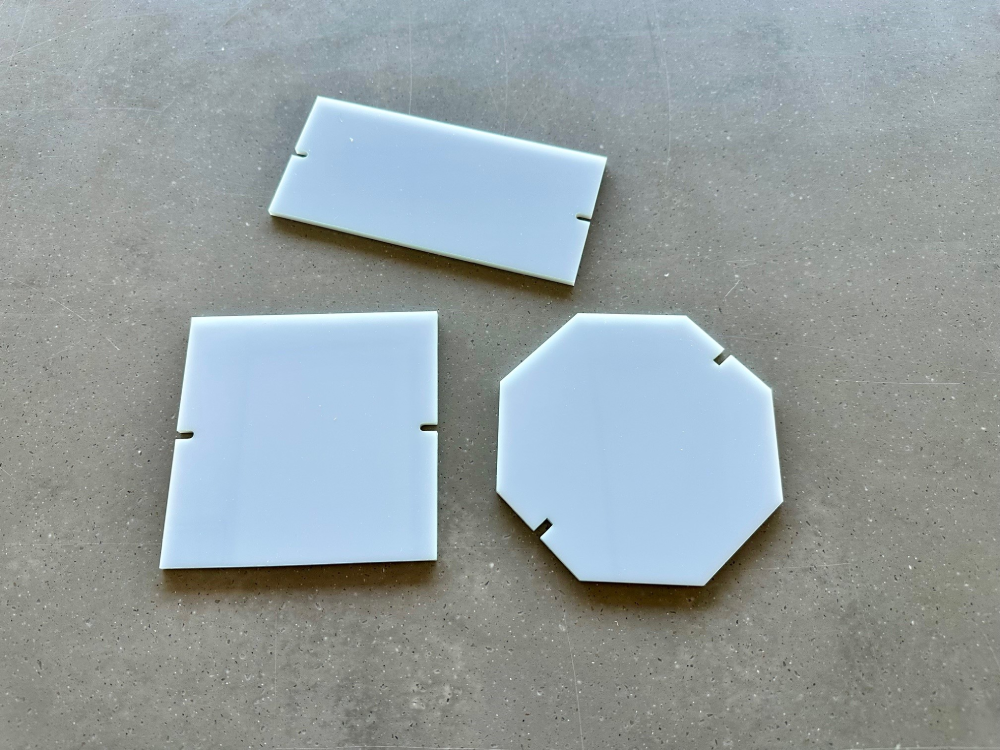
Any grid, any hole size, any plate dimension. Two across by two down for a small feeder run, six across by two down for a main bank, tall narrow cards for stacked runs in a shared trench. Mixed hole sizes on one plate where a bank carries more than one conduit diameter.
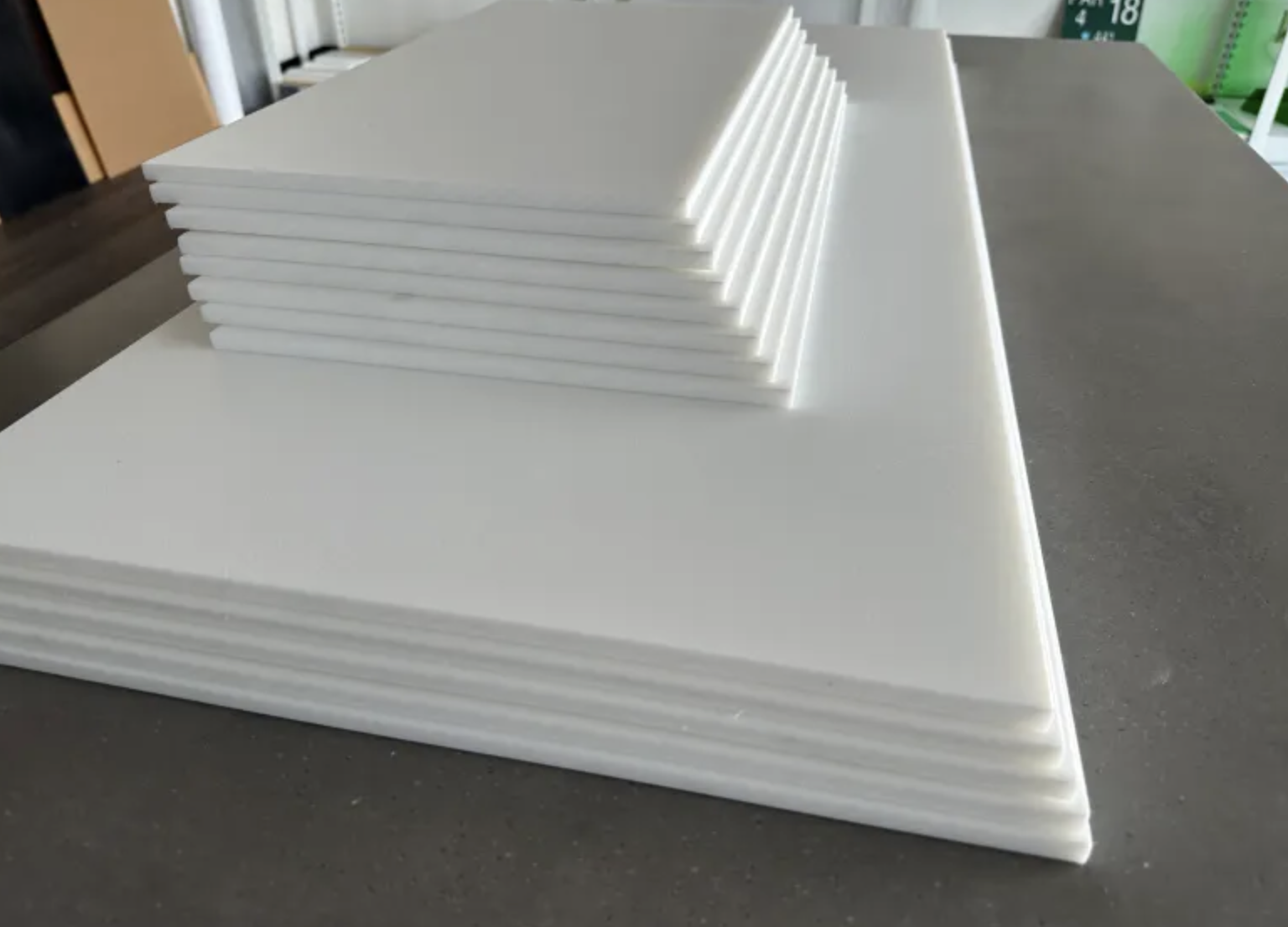
Trench cards get cut from HDPE, and almost every schedule that crosses our desk calls for 1/2″. Some call for 3/8″. Both are on the rack in Sparks, so neither is a lead time.
| Thickness | Decimal | Edge on, to scale | Where it lands |
|---|---|---|---|
| 1/2″ | 0.500″ | The usual call. Most schedules we quote. | |
| 3/8″ | 0.375″ | Specified on lighter banks and smaller conduit. |
Drawn at the same scale as every other gauge on this site. If your drawing calls for something else, we stock HDPE from 1/8″ through 1″ and source heavier — see the full HDPE stock list. Thickness is an engineering call on your set, not ours. If the schedule does not state one, say so and we will flag it back rather than pick one and hope.
We cut trench cards in both, and this is one of the few parts where reprocessed HDPE is the right answer rather than the cheap one. Worth two minutes before you spec it.
Reprocessed HDPE also varies more sheet to sheet than virgin does, and its color is whatever the run happened to be. On a buried spacer neither matters. On anything structural, visible, or certified, they both do — which is why we ask what the part is instead of just quoting the cheaper sheet.
If your specification calls for PVC or polypropylene instead, we stock and cut both. Send the spec section and we will confirm in writing what we are cutting before the first sheet goes on the table.
We are the fabricator, not the engineer of record. Burial depth, duct bank geometry, conduit spacing, card interval down the trench and thickness are all set by your stamped drawings and the code your AHJ enforces. We are not going to publish a spacing rule on a web page and have someone build to it instead of their own set. What we will do is cut exactly what the schedule says, tell you when something on it looks wrong before we cut it, and put it on the jobsite on the day you need it.
A flat plastic plate with a grid of holes that the conduits pass through, set at intervals down a trench to hold a duct bank in position. It keeps every conduit on its designed spacing while the bank is backfilled or encased in concrete, so the array does not sag, drift or collapse together. You will also see them called duct bank spacers or conduit spacers — same part, different regional habit.
Yes, and that is the fastest way to buy them. Send the trench card schedule out of your drawing set — the table with the type codes, length, height, hole diameter, hole counts and quantities — and we quote off it directly. No takeoff on your side, no retyping dimensions into an order form, no drawing anything again.
HDPE, in virgin or reprocessed. It is non-conductive, it does not corrode or rot in the ground, and it absorbs effectively no water, which matters for a part that spends its life buried in wet concrete. Reprocessed is usually the sensible buy on a trench card — buried, unseen, no certification required — and on a schedule running to thousands of cards the saving is real. If your spec names virgin material or the submittal needs mill paperwork, we cut virgin and supply it. We will not substitute one for the other without telling you.
1/2″ on most schedules we see, and 3/8″ on lighter banks. Both are stocked in Sparks, so neither carries a lead time. If your drawing calls for something else we stock HDPE from 1/8″ through 1″ and source heavier. Thickness is an engineering call on your set rather than ours — if the schedule does not state one, tell us and we will flag it back instead of picking one.
A duct bank job is not a few cards — a single schedule regularly runs to several thousand across a dozen or more types. That is normal work for us. We CNC rout them from sheet in our Sparks shop, so the run rate is set by machine time rather than by waiting on a supplier. Tell us your pour dates and we will tell you straight what we can hit.
Yes. The hole diameter is whatever your schedule specifies — it is normally the conduit outside diameter plus a working clearance, and that clearance is your engineer’s call, not ours. We cut the hole you specify. If your schedule gives conduit trade size instead of a hole diameter, tell us and we will confirm the hole with you in writing before anything is cut.
Routinely. Corner tie holes, notches, radiused corners, slots for banding, staggered and offset hole patterns, and cards with mixed hole sizes on the same plate for a mixed-diameter bank. If it is on the drawing we can cut it.
Free, across Reno, Sparks, Carson City, Fernley and USA Parkway. Data center work along USA Parkway is inside our normal delivery run. Tell us the gate, the laydown yard and who to call on arrival and we will work to your site rules.
Working a duct bank in Northern Nevada? Send the schedule to request a quote or call (775) 358-8211. · HDPE sheet specs → · CNC routing →
Made-to-order work does not go out in an hour, and we are not going to tell you it does. Here is what you actually get.
"No minimum order, no attitude."
Fill out the form below and we'll get back to you with a quote — most within the same day. Or call us at (775) 358-8211.
Every material and product we carry can be customized with our full range of fabrication services.
Walk into our Sparks shop with your measurements or call us — most quotes returned same day. No minimum order, free delivery in Reno, Sparks, Carson City, Fernley and USA Parkway.