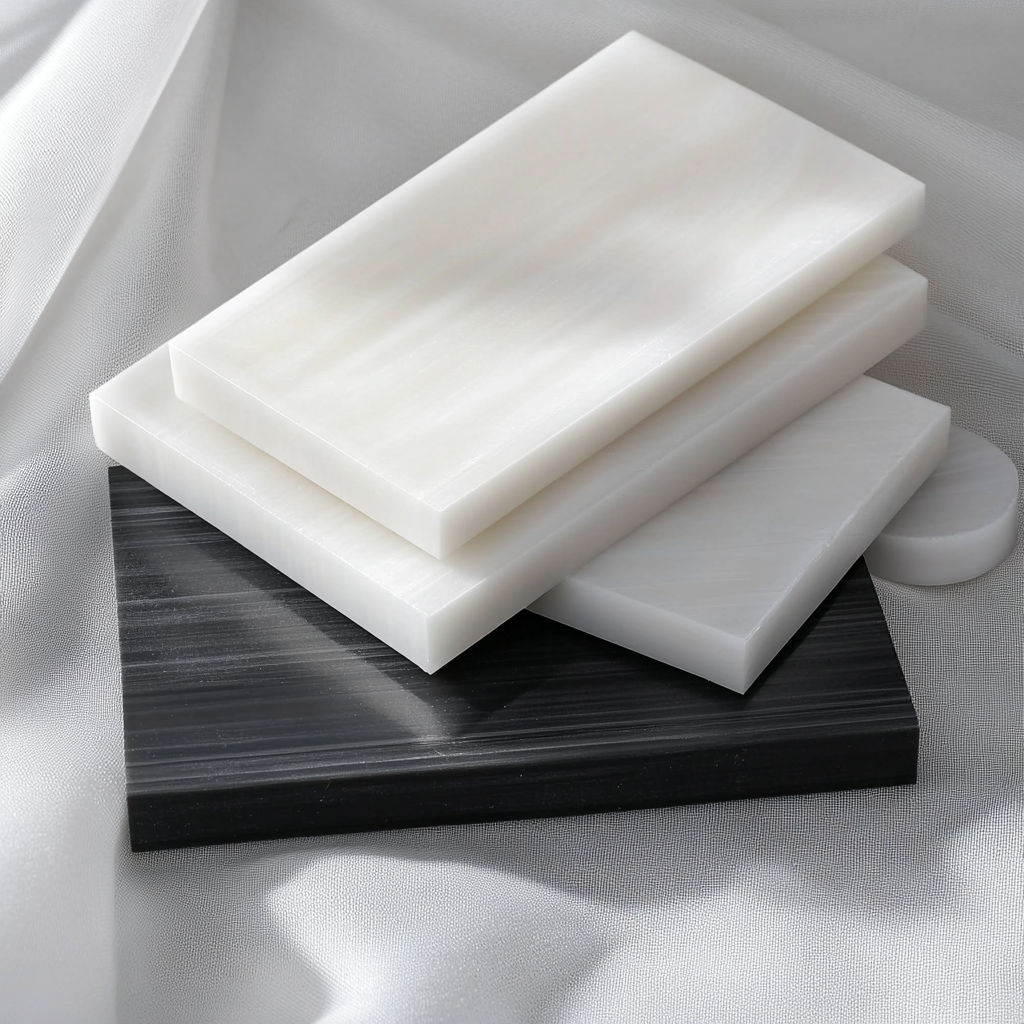
White polypropylene and SIMONA FRPP flame retardant sheet, UL 94 V-0, stocked 1/4″ to 1/2″ in Sparks, NV. Cut, routed and welded to your drawing.
Polypropylene is the chemical-service cousin of HDPE — welds the same way, holds up better against acids as the temperature climbs. What makes it worth a phone call is the second grade on our rack: SIMONA® PP-C Flame Retardant, rated UL 94 V0. That is the sheet a lab exhaust duct, a fume scrubber or a flammable-storage ventilation run gets specified in, and it is not a material anybody else around here keeps on the floor.
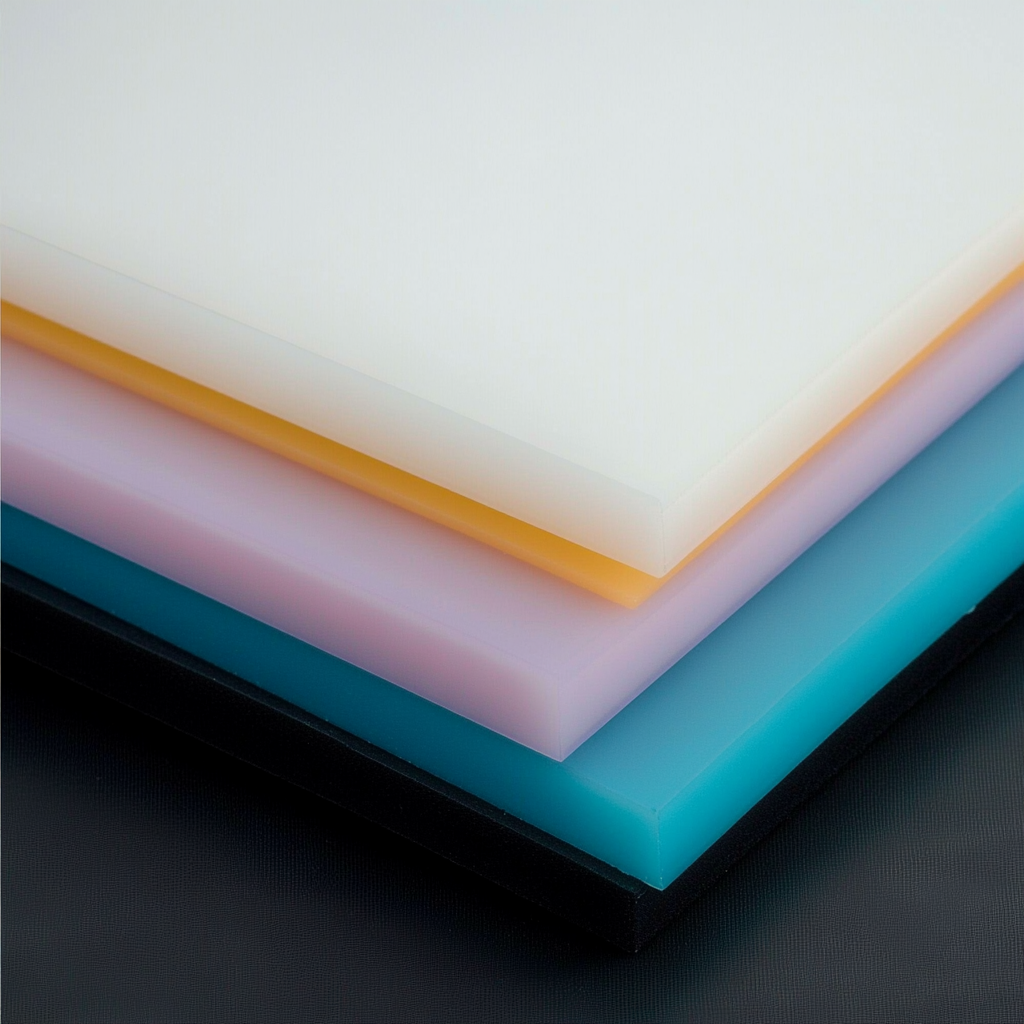
Two grades on the floor in Sparks, both in 48″ × 96″ sheet, cut to size in our shop. Standard white/natural PP for general chemical and fabrication work; SIMONA FRPP-VO where a specification or a building code calls for a flame retardant grade. The gauges are drawn edge-on beside each size, all at the same scale.
| Thickness | Decimal | Edge on, to scale | Grades stocked |
|---|---|---|---|
| 1/4″ | 0.250″ | White/natural PP · FRPP-VO | |
| 3/8″ | 0.375″ | White/natural PP · FRPP-VO | |
| 1/2″ | 0.500″ | White/natural PP · FRPP-VO | |
| 3/4″ | 0.750″ | White/natural PP only |
Thinner and thicker gauges, grey, rod, and welding rod come in on a short lead time through the same mill. Tell us the thickness and the grade and we will confirm whether it is a stock cut or a few days out before you plan around it.
V-0 is the strictest of the UL 94 vertical burn classifications. A specimen has to self-extinguish within ten seconds after the flame is removed, and it is not allowed to drip flaming particles onto the cotton below it. Standard polypropylene does not come close — it burns, and it drips. That difference is the entire reason the FR grade exists and the reason it costs several times what white PP costs.
The grade we stock is SIMONA® PP-C Flame Retardant, and its technical data sheet carries the V0 classification outright. We keep that data sheet on file, we stock the material in 1/4″, 3/8″ and 1/2″, and we weld it in the same shop that welds the standard grade. The sheet is below — you should not have to chase a supplier for the document that gets your submittal approved.
SIMONA PP-C is the sheet we hold for ducting, enclosures and general fire-rated work. There is a second flame retardant polypropylene worth knowing about, and it is aimed somewhere different: Vycom FlameTec® CP-5, a flame retardant copolymer formulated for cleanroom fit-out — laminar air flow stations, biological safety cabinets, fume hoods and the accessories around them. It is UL 94 V-0 like the SIMONA grade. We bring it in to order and cut it before it ships.
The number that stands out on it is impact. Notched Izod is 17 ft-lb/in — high for a polypropylene, because it is a copolymer rather than a homopolymer. On a cleanroom panel that gets knocked by a cart every week, that is the difference between a scuff and a crack.
| FlameTec CP-5 property | Test method | Value |
|---|---|---|
| Density | ASTM D 792 | 0.99 g/cm³ |
| Water absorption | ASTM D 570 | 0.01% |
| Tensile strength | ASTM D 638 | 3,500 psi |
| Flexural modulus | ASTM D 790 | 135,000 psi |
| Notched Izod impact | ASTM D 256 | 17 ft-lb/in |
| Heat deflection @ 66 psi | ASTM D 648 | 186°F |
| Vicat softening point | ASTM D 1525 | 264°F |
| Vertical burn test | UL 94 | V-0 |
Vycom published typical properties, FlameTec CP-5 data sheet PDS505, Plaskolite LLC. Typical properties are not specification values. CP-5 is not an FM 4910 material — Vycom describes it as the option for when a Factory Mutual listing is not required. If your cleanroom spec names FM 4910, say so and we will source to it rather than send you this.
Flame retardant polypropylene is rarely bought on preference. It is bought because a drawing, an inspector or a standard requires it. These are the ones that come up most:
| Standard | What it requires | Where it bites |
|---|---|---|
| IBC Section 717 | Duct penetrating a fire-rated wall, floor or ceiling: flame spread index 25 or less and smoke developed index 50 or less per ASTM E84. | Any exhaust run that crosses a rated assembly. |
| IMC Section 510 ANSI Z9.5 |
Laboratory exhaust ductwork must resist corrosive chemicals and carry a flame spread index of 25 or less. | University chemistry, pharma, analytical labs, fume hood exhaust. |
| NFPA 30 | Ventilation ductwork in flammable liquid storage rooms must be non-combustible or limited-combustible. | Solvent stores, paint rooms, chemical storage buildings. |
| UL 94 V-0 | Material classification for electrical enclosures and components. Self-extinguishing, no flaming drips. | Enclosures, insulating panels, equipment housings. |
Bring us the spec, not just the material name. UL 94 V-0 is a material classification, not a code approval, and ASTM E84 is a different test on a different apparatus. If your drawing calls out a flame spread index, a smoke developed index, an E84 class, or FM 4910 — which is a separate SIMONA grade, not this one — tell us before we cut. We will get the manufacturer’s certificate for the exact sheet we ship you, in writing, so it goes into your submittal package instead of holding it up. That is a phone call for us and a two-week problem for a supplier who has to order the material first.
These grades come in to order. The sheet you download is the sheet we quote from.
These are two genuinely different materials, and the differences run the opposite way to what people assume. The flame retardant grade is a copolymer carrying a retardant package, so it is heavier and slightly lower in tensile than standard polypropylene. If you are sizing hangers or checking a load, use the right column — not the generic polypropylene numbers in a handbook.
| Property | White/natural PP typical | SIMONA® PP-C FR data sheet |
|---|---|---|
| Specific gravity (ASTM D792) | 0.90–0.91 | 1.01 — does not float |
| Tensile strength at yield (D638) | 4,500–5,000 psi | 3,900 psi |
| Elongation at break (D638) | > 100% | > 100% |
| Flexural modulus (D790) | ~170,000 psi | 160,000 psi |
| Izod impact, notched (D256) | 1–2 ft·lb/in (homopolymer) | 7.0 ft·lb/in — copolymer toughness |
| Shore hardness D (D2240) | ~70 | 67 |
| Continuous service temp, max | ~180°F | 180°F |
| Heat deflection @ 66 psi (D648) | — | 180°F |
| Melting point (D3418) | ~330°F | 334°F |
| Water absorption (D570) | < 0.02% | < 0.01% |
| Flammability | UL 94 HB — it burns | UL 94 V0 |
| Weldability | Hot-gas / extrusion | Hot-gas / extrusion, matching FR rod |
| UV stability | Poor unstabilised | Poor unstabilised — indoor and enclosed service |
Right-hand column is taken from SIMONA®’s technical data sheet for PP-C Flame Retardant, revision 09.09.2019. SIMONA notes those figures are averages from extruded sheet at 4 mm and are a planning guide rather than a guarantee of properties — which is exactly why we hand you the data sheet with the quote instead of retyping numbers onto an invoice. Left-hand column is typical published values for general-purpose polypropylene sheet.
This is the detail that catches people out. The retardant package makes the FR grade about 11% heavier than standard polypropylene and heavier than HDPE — and unlike standard PP, it will not float. On a long overhead duct run that is a hanger-spacing question, not a trivia question. Either grade is still roughly an eighth the weight of the same thing in steel, and neither corrodes when what you are exhausting is acidic.
Polypropylene moves roughly twelve times as much as steel. On a long duct run, a tank wall, or any panel fastened between structure, build in clearance and use slotted holes. Skipping that is the usual reason a weld line cracks or a panel bows a season after it went in.
They weld the same way and they look similar on the rack, so the choice comes down to chemistry and heat. HDPE is cheaper, more ductile and the default for water, mining and food service. Polypropylene holds its chemical resistance better as the service temperature climbs, which is why acid tanks and hot process work go to PP. Standard white/natural PP is also the lighter of the two; the FR grade is the heavier, so do not carry one assumption across both. And only PP comes in a flame retardant grade we stock. If the job is warm, acidic, or has a fire rating attached to it, that is a polypropylene job. If it is a wear pad or a slide strip, read the material comparison on the wear strips page first, because PP is the stiffest of the three and the worst in abrasion. HDPE sheet →
Polypropylene cuts and routs with ordinary woodworking tooling — sharp tools, clear the chip, keep it cool and it finishes clean. Like every polyolefin it will not solvent-cement and it will not take paint, so joints get welded and graphics get applied or engraved. We cut it to size, CNC rout it, and hot-gas and extrusion weld it into finished assemblies in Sparks. Bring a drawing, a broken part, or the duct fitting you need matched.
No, and it matters. UL 94 V-0 is the grade we stock — a material flammability classification used for enclosures, duct and general FR work. FM 4910 is a separate Factory Mutual test built around cleanroom fire and smoke behaviour, and it is a different SIMONA product. Semiconductor fabs and some pharma specs call out FM 4910 specifically. We can order it; we do not stock it. If your drawing says FM 4910, say so up front rather than accepting V-0 as equivalent, because it is not.
Yes, and it surprises people. Standard polypropylene runs about 0.905 specific gravity and floats. SIMONA® PP-C Flame Retardant is 1.01 — roughly 11% heavier, heavier than HDPE, and it sinks. The flame retardant package is a real additive load, not a coating. On a short run nobody notices; on a long overhead duct it changes your hanger spacing. It also yields slightly earlier in tension — 3,900 psi against roughly 4,500 for standard PP — while being considerably tougher on notched impact, because it is a copolymer. Design to the FR numbers, not to generic polypropylene figures.
Yes. It hot-gas and extrusion welds like standard polypropylene, using matching FR welding rod so the joint carries the same rating as the sheet. That last part gets missed — welding an FR sheet with standard rod puts a non-rated seam through the middle of a rated assembly. We use matching rod and we will say so on the quote.
The flame retardant package is a real additive load, the resin is a specialty grade produced in far smaller volumes, and it carries testing and certification behind it. Expect several times the price of standard sheet. That is why nobody stocks it on spec and why, when your inspector asks for it on a Thursday, having it forty feet away is worth something.
Around 180°F continuous, with short excursions above that. It holds chemical resistance better than HDPE as it warms, which is the usual reason to pay for PP over HDPE on a hot acid service. Above that range you are into a different family — tell us the service temperature and the chemistry together and we will point you at the right sheet rather than the one we happen to stock.
Not for long unstabilised. Polypropylene chalks and embrittles in sustained UV, so plan on indoor, enclosed or shaded service unless you specify a UV-stabilised grade. If the run is partly outdoors, tell us which part and we will spec accordingly.
Yes — that is what the welding shop is for. Duct, transitions, hoods, plenums, scrubber bodies and tanks fabricated to your drawing in Sparks, in standard or FR grade, with the material certificate to go with them. Local fabrication on a code job is usually the difference between hitting an inspection date and moving it.
We stock it here and we run our own van. Three ways to get material — take the one you need.
"Outstanding craftsmanship and customer service. They went above and beyond on my project."
Fill out the form below and we'll get back to you with a quote — most within the same day. Or call us at (775) 358-8211.
Every material and product we carry can be customized with our full range of fabrication services.
Walk into our Sparks shop with your measurements or call us — most quotes returned same day. No minimum order, free delivery in Reno, Sparks, Carson City, Fernley and USA Parkway.