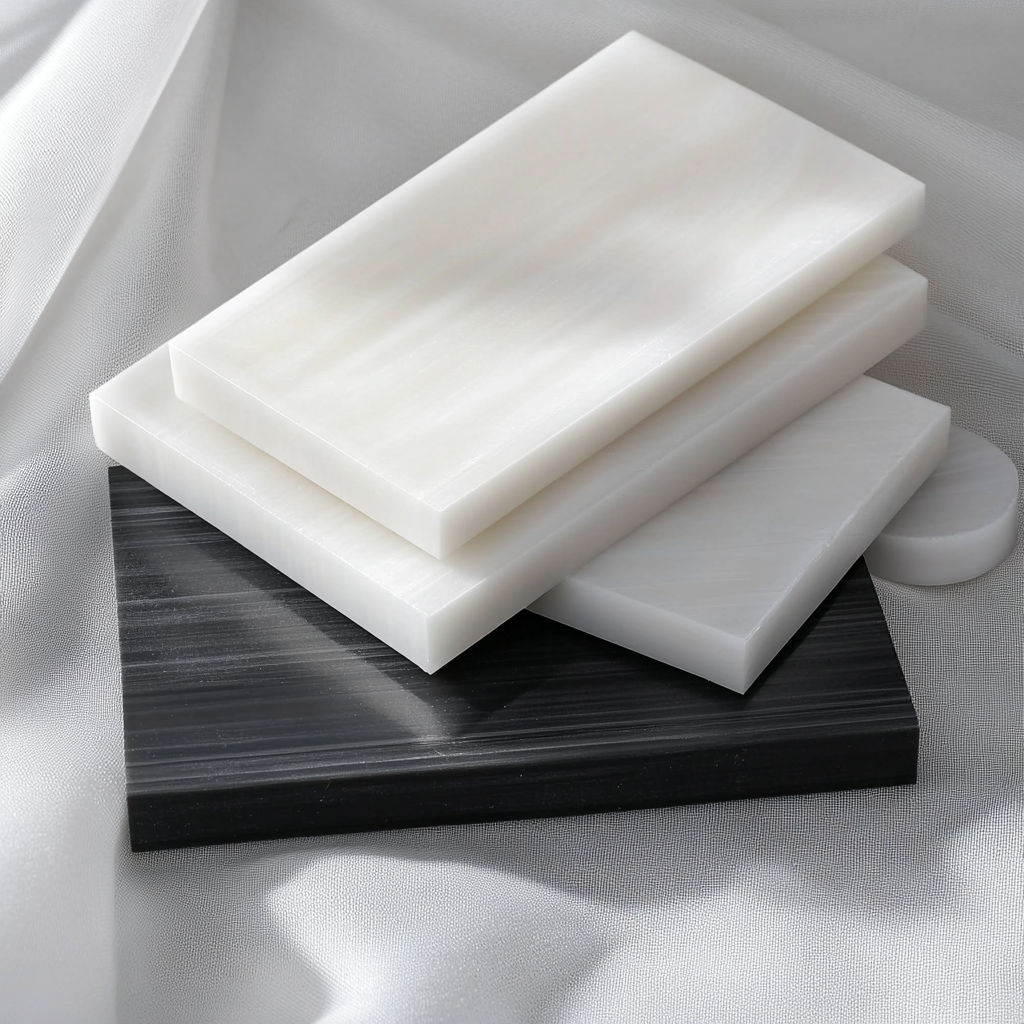
Foam board, PVC foam, expanded PVC — same sheet. Stocked black and white in Sparks, NV, 1/8″ to 3/4″ in 4×8 and 4×10, cut and routed to size. Rigid grey PVC too.
Most people who call us about this ask for foam board. On the spec sheet it is expanded PVC — a closed-cell rigid foam sheet, light, dead flat and matte. It cuts on a table saw, routs without chipping, takes a screw straight into the edge, and prints direct on a flatbed. That combination is why it has quietly replaced MDF and plywood for interior signs, displays and exhibit work. We stock it in black and white by the pallet in Sparks and cut it to your sizes.
Foam board, PVC foam, expanded PVC — all the same sheet. Most of our customers ask for foam board or PVC foam; the data sheet and the technical drawings say expanded PVC. If a spec calls for Sintra, Komatex, Celtec or Palight, those are brand names for this material too — same product, different label on the pallet. And “vinyl” is the everyday word for PVC generally, though in a sign shop it usually means the printed film that goes on the board rather than the board itself. Ask for whichever one you know it by — and if a drawing calls out a name you do not recognise, we keep a translation list of every brand name we get asked for.
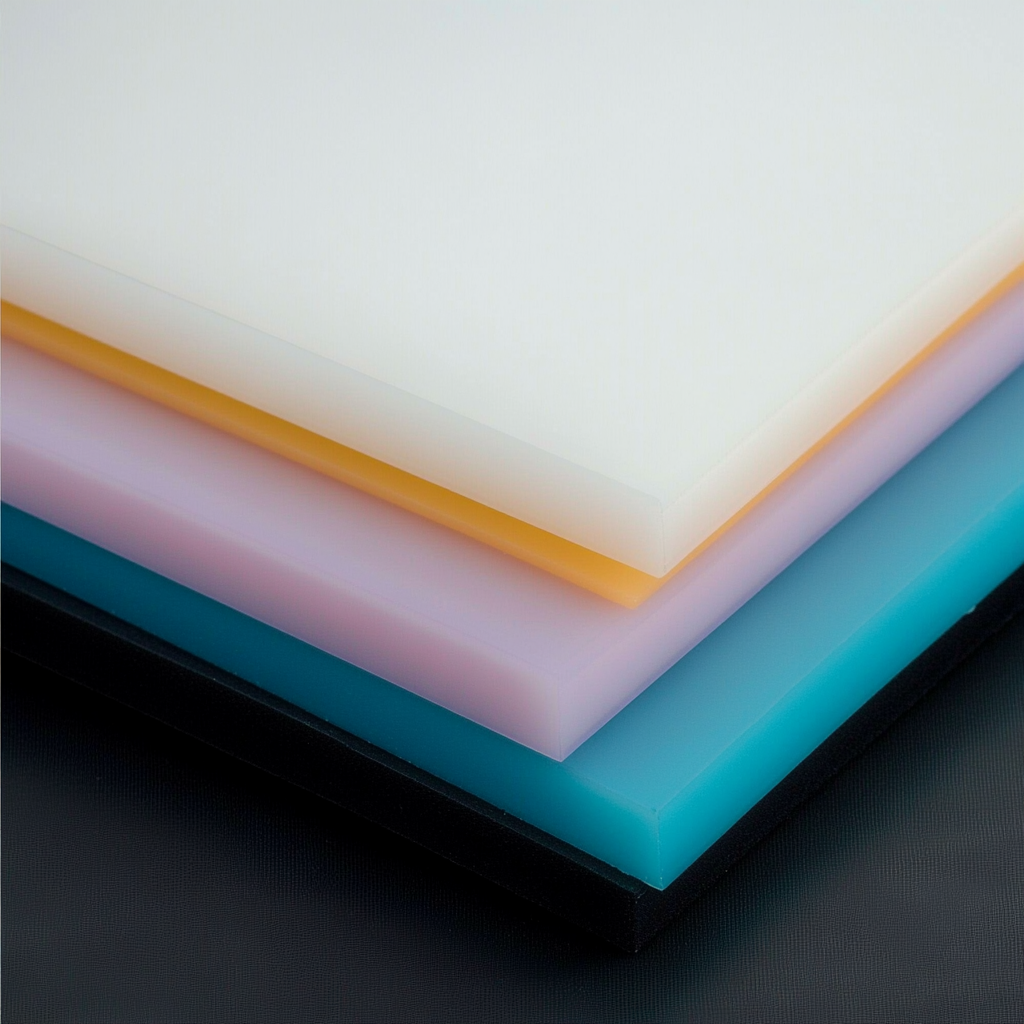
Expanded PVC on the floor in black and white, in the thicknesses below, cut to size same day. Standard sheet is 48″ × 96″, with 48″ × 120″ stocked in the heavier gauges for tall panels and long runs. The gauges are drawn edge-on beside each size, all at the same scale, so you can see the difference rather than work it out.
| Thickness | Metric | Edge on, to scale | Colors | Sheet sizes |
|---|---|---|---|---|
| 1/8″ | 3 mm | Black, White | 4×8 | |
| 1/4″ | 6 mm | Black, White | 4×8 | |
| 1/2″ | 12 mm | Black, White | 4×8, 4×10 (black) | |
| 3/4″ | 19 mm | Black, White | 4×8, 4×10 (black) |
One piece or a full pallet. Colors beyond black and white — and thinner 2 mm stock for wraps and returns — come in on order with a short lead time. Tell us the thickness and quantity and we will confirm whether it is a same-day cut before you plan around it.
Expanded and rigid PVC are the same polymer in two very different forms, and people ask for both under one name. Rigid PVC — solid, dense, grey, Type 1 — is the chemical-service material: tank linings, ducting, valve and pump components, splash guards in plating and process work. We keep 1/2″ grey in 60″ × 120″ and bring in other gauges to order. If your reason for asking about PVC is chemical resistance rather than signage, that is the sheet you want, and it is worth a phone call so we point you at the right one.
| Property | Typical value | What it means on the job |
|---|---|---|
| Density | 0.5–0.6 g/cm³ | Roughly half the weight of solid PVC and a third of acrylic |
| Structure | Closed-cell rigid foam | Homogeneous through the thickness — no core to delaminate at a cut edge |
| Surface | Matte, low gloss | Prints and paints without primer; no glare under retail lighting |
| Water absorption | Negligible | Will not swell, rot or delaminate in damp service |
| Service temperature | Up to about 150°F | Interior and shaded exterior. It will soften and bow in a hot closed sign cabinet |
| Thermal expansion | ~6× steel | Large panels need clearance and slotted holes — see the chart below |
| Flammability | Self-extinguishing | Most brands carry a Class A / Class 1 rating — confirm the data sheet for permitted work |
| Joining | PVC cement, screws, adhesive | Solvent welds to itself, and unlike polyethylene it takes glue and paint readily |
| Forming | Strip heater / low-temp bend | Bends to a clean radius with heat for returns, trays and dimensional work |
| UV stability | Moderate | Good for interior and medium-term exterior. Colors fade and white chalks over years of direct sun |
Typical published values for expanded PVC sheet, given as a design starting point. Figures vary between brands and between thicknesses within a brand. For fire-rated, structural or code-driven work, ask and we will supply the manufacturer data sheet for the specific board.
A half-inch sheet of expanded PVC is about a quarter lighter than MDF and less than half the weight of acrylic. On a wall-mounted sign or a hanging display that is not a spec detail — it decides the fastener, the substrate behind it, and whether one person can hang it.
A ten-foot panel can move more than half an inch across a hundred-degree swing between a winter night and a summer afternoon. Use oversized or slotted holes, leave clearance at every edge, and never trap a long panel tightly between structure. This is the most common reason a sign bows or pulls a fastener a year after it went up.
These grades come in to order. The sheet you download is the sheet we quote from.
These are the two substrates a sign shop chooses between, and they split cleanly. Expanded PVC when the part gets shaped — routed letters, cut profiles, screwed edges, heat-formed returns — or when it lives indoors or in the wet. Aluminum composite when the part is a large flat panel outdoors — it is stiffer per pound, stays flatter over a long span, and holds colour in full sun for years rather than seasons. Picking expanded PVC for a big exterior panel is how a sign ends up wavy by its second summer. We stock both in Sparks; tell us where the sign is going and we will tell you which one it wants. Full side-by-side with the numbers → · ACM / Dibond →
Expanded PVC is one of the friendliest sheets in the building to work. We cut it to size while you wait, CNC rout letters, logos and shaped panels from your file, and fabricate trays, returns and assemblies from it. It solvent-cements to itself, so a built-up piece can be genuinely seamless. Note it is not a laser material — PVC releases chlorine gas when lasered, which damages the machine and is a health hazard, so shaped work goes on the router. Delivery is free in Reno, Sparks, Carson City, Fernley and USA Parkway.
No, and it is worth being sure which one you want. Foam core — the light paper-faced board from an art or craft shop — is a polystyrene foam between two paper skins. It dents, it will not take a screw, and it turns to mush if it gets wet. PVC foam board is solid plastic all the way through: it routs, holds a fastener, and shrugs off water. If you have been sent for “foam board” and it is going on a wall, in a bathroom, or through a router, this is the one you want. If you genuinely need the paper-faced kind, say so and we will point you somewhere.
Yes. Sintra, Komatex, Celtec and Palight are brand names for expanded PVC foam board. The board differs a little between brands in density and surface, but if a drawing or a customer calls for Sintra, this is the material. Tell us the brand you have specified and we will tell you whether what is on our floor matches it.
No, and no reputable shop will. Lasering PVC releases chlorine gas, which corrodes the machine from the inside and is genuinely hazardous to breathe. Shaped work in PVC goes on the CNC router instead, which gives a cleaner edge on foam board anyway. If a job really needs laser work, acrylic is the material to switch to.
For a while. It will not rot or absorb water, which is the failure mode wood has outdoors, but sustained direct sun fades colors and chalks white boards over a few years, and heat will bow a large unsupported panel. It is a good choice for a shaded exterior sign or a seasonal one, and the wrong choice for a large permanent panel in full sun — that is what aluminum composite is for.
Yes, directly, including into the edge of thicker sheet — one of the main reasons fabricators like it. Do not overtighten; it is foam, and a screw will strip if you drive it like it is timber. For anything load-bearing or repeatedly removed, use a threaded insert.
Yes. The matte face takes UV flatbed ink, solvent print and vinyl without primer, and it paints readily. White is the standard for printed work; black is used for backers, returns and edges you would rather not see.
Same polymer, different form and different job. Expanded PVC is a foam board for signs and displays. Rigid PVC is solid, dense and usually grey, and it is bought for chemical resistance — tanks, ducting, splash guards, valve components. If your application involves chemicals rather than graphics, you want the rigid sheet.
We stock it here and we run our own van. Three ways to get material — take the one you need.
"Brought in a sketch on a napkin and they turned it into exactly what I needed. Same day."
Fill out the form below and we'll get back to you with a quote — most within the same day. Or call us at (775) 358-8211.
Every material and product we carry can be customized with our full range of fabrication services.
Walk into our Sparks shop with your measurements or call us — most quotes returned same day. No minimum order, free delivery in Reno, Sparks, Carson City, Fernley and USA Parkway.